Overview
Tags help organizations categorize conversations, customers, and AI Agent interactions for classification, automation, reporting, and analysis. Different tag types serve different purposes, including general classification, Knowledge Base topics, and AI Agent performance evaluation.
You can create, edit, delete, and organize tags into groups, assign ownership to specific teams, and define where tags should be used.
CommBox also supports additional tag types, such as Intent and Customer Satisfaction tags, which are managed through their respective features.
You can also create all tag types using the CommBox API.
Key Considerations
-
Tag Type is used to categorize tags according to their business purpose, making them easier to organize and manage.
-
CommBox supports six tag types:
- Tag – General-purpose tags for conversations and customers.
- Goal – General-purpose tags for conversations and customers.
- Miss – General-purpose tags for conversations and customers.
- Topic – Tags used to categorize Knowledge Base items, conversations, and customers, helping organize related information.
- Satisfaction – Configured in the Customer Satisfaction settings. When a customer responds to a satisfaction survey, the corresponding tag is automatically added to the conversation, with an optional emoji. Agents cannot delete Satisfaction tags. See the Customer Satisfaction guide.
- Intent – Automatically added to conversations when an intent is identified. See the Intents guide for more information.
-
Tag Groups allow organizations to organize related tags for easier management.
-
Valued Tags can be configured with a range of numeric values and a default value. These values provide additional information about the tagged conversation or customer and can help when filtering conversations.
-
Eva, CommBox's AI Agent evaluator, can use any tag that has an Eva tag description to evaluate AI Agent conversations. Eva uses the description, rather than the tag name, to determine when to apply the tag. Evaluation tags are added when a conversation is Resolved.
-
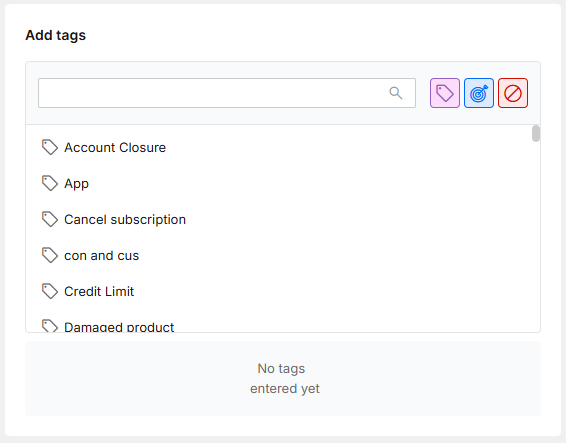
Rules can be triggered by tags and can automatically add tags to conversations or customers. See the Rules guide for more information.
-
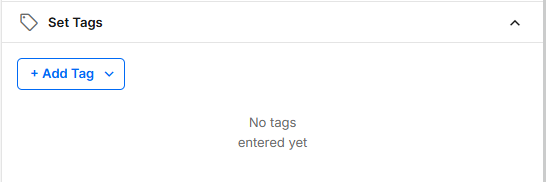
Automation Bots can add tags to conversations or customers at any step in a Flow. In the relevant step's properties, select Set Tags, click + Add Tag, select the desired tags, and click OK.
-
Team Assets control tag availability according to the organization's team hierarchy. Tags can be managed through the Teams module or the Tags management page. See Understanding Teams Assets for more information.
Displaying Tags
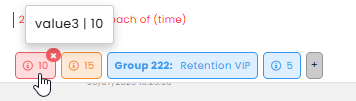
Tags are displayed with their group name (in bold), tag name, and value, when applicable.
For valued tags, only the value is displayed. Hover over a tag to view its complete information.
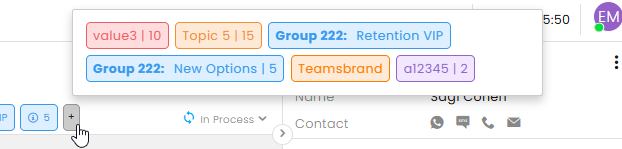
When there is insufficient space to display all tags, click the + icon next to the visible tags to view the complete list.
Managing Tags
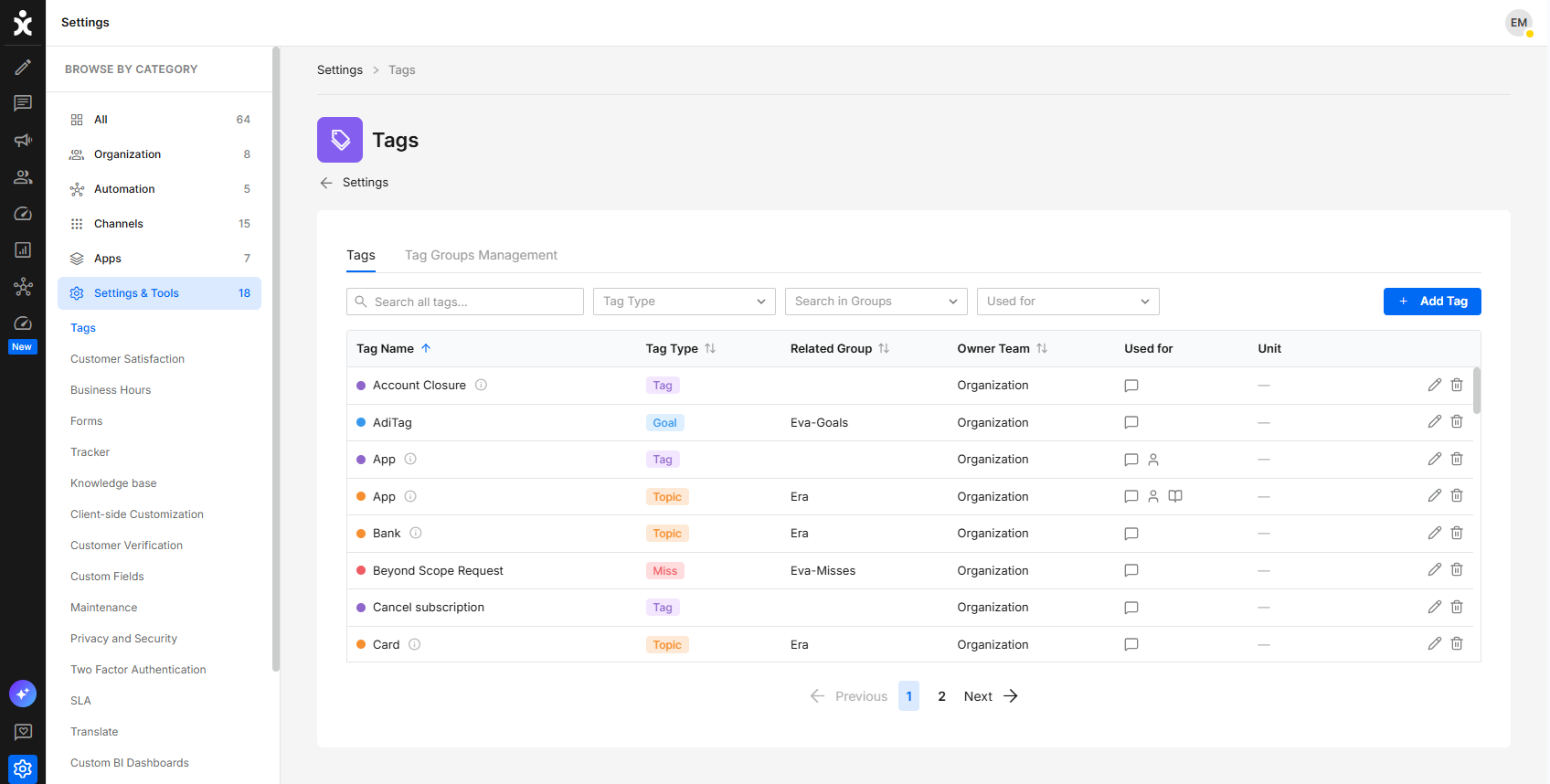
Navigate to Settings > Tags in the Settings & Tools section to view and manage existing tags.
The Tags tab displays all available tags and their properties:
- Tag Name – The name of the tag.
- Tag Type – The tag's classification, such as Tag, Topic, Goal, or Miss.
- Related Group – The group to which the tag belongs, if applicable.
- Owner Team – The team or organization that owns the tag.
- Used for – Icons indicating where the tag can be used: Conversations, Customers, or Knowledge Base items.
- Unit – Indicates whether the tag has a numeric value.
Searching for a Tag
You can search for tags by name or filter the list by Tag Type, Related Group, or Used for.
Click a column heading to sort the list. Use the arrows next to the column heading to switch between ascending and descending order.
Adding a Tag
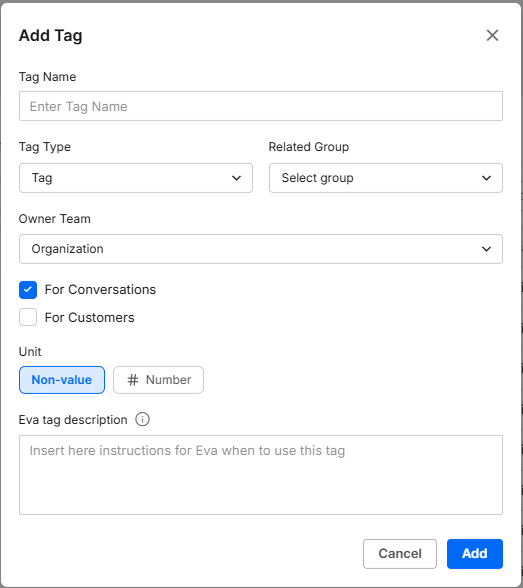
- Navigate to Settings > Tags in the Settings & Tools section, and click + Add Tag.
- Complete the following fields:
- Tag Name – Enter a name for the tag.
- Tag Type – Select a category for the tag based on its business purpose.
- Related Group – Select the group to which the tag belongs, if applicable.
- Owner Team – Select the team that owns the tag, or Organization to make it available at the organization level.
- For Conversations – Select to enable the tag for conversations.
- For Customers – Select to enable the tag for customers.
- For Knowledge Base – Select to enable the tag for Knowledge Base items. This option is available only for Topic tags.
- Unit – Select Non-value for a tag without a numeric value, or Number for a tag that stores a numeric value. For numeric tags, configure the value range and default value.
- Eva tag description – Enter instructions describing when Eva should apply the tag during AI Agent conversation evaluations.
- Click Add to save the tag.
Note: Eva uses the Eva tag description, not the tag name, to determine when to apply evaluation tags. Provide clear instructions describing the conditions under which the tag should be assigned.
Editing a Tag
- Locate the tag in the Tags list.
- Click the desired row or the Edit (pencil) icon.
- Update the required fields.
- Click Save to apply your changes.
Deleting a Tag
- Locate the tag in the Tags list.
- Click the Delete (trash) icon.
- Confirm the deletion.
Important: Deleting a tag permanently removes it from all locations where it is used. This action cannot be undone.
Managing Tag Groups
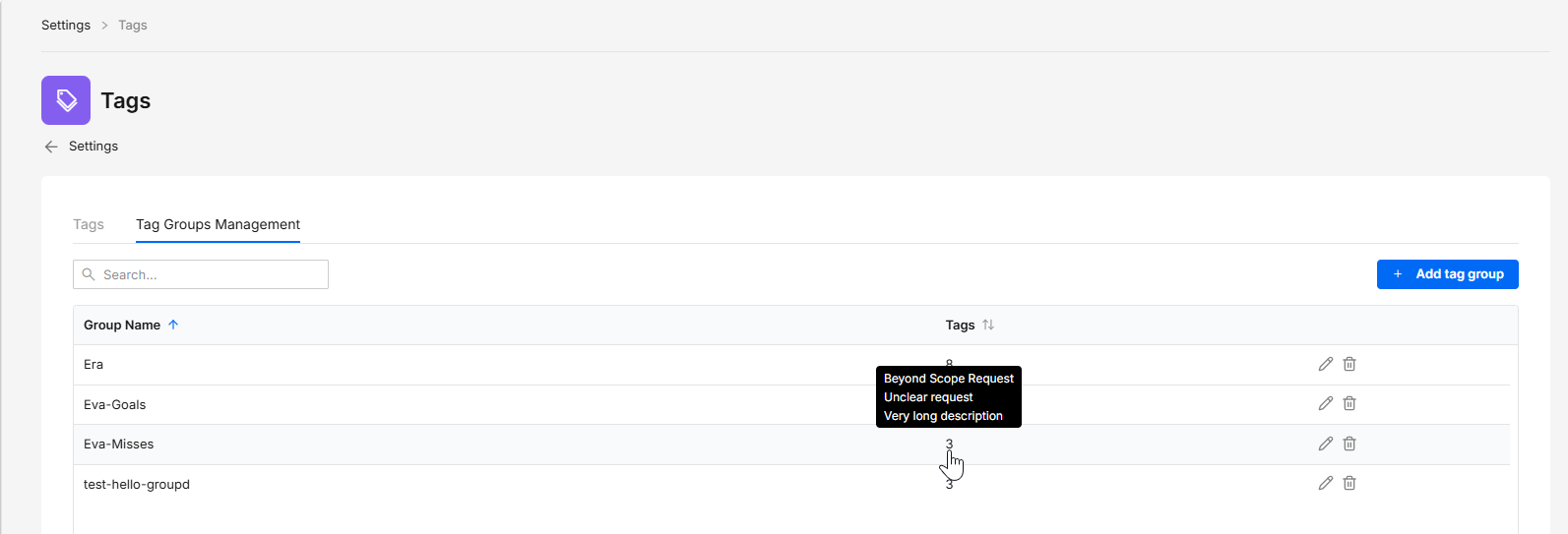
Tag Groups help organize related tags according to the organization's business needs.
Navigate to Settings > Tags and select the Tag Groups Management tab.
The table displays the number of tags associated with each group. Hover over the number to view the list of tags belonging to that group.
Creating a Tag Group
-
Open the Tag Groups Management tab and click the +Add tag group button.
-
Enter a name for the group.
.png)
-
Save the group by clicking Add.
Once created, the group can be selected in the Related Group field when adding or editing tags.
Editing a Tag Group
- Locate the group in the Tag Groups Management tab.
- Click the Edit (pencil) icon.
- Update the group name.
- Save your changes.
Note: Only the group name can be edited from this tab. To modify tags associated with the group, edit them individually from the Tags tab.
Deleting a Tag Group
Deleting a Tag Group also permanently deletes all tags associated with it. This action cannot be undone. Changes are reflected after a browser refresh.
Important: To preserve the associated tags, edit each tag and remove its association with the group before deleting the group.
Once the group contains no tags:
- Locate the group in the Tag Groups Management tab.
- Click the Delete (trash) icon.
- Confirm the deletion.
Tags in Teams
Tags are managed as Team Assets. The Owner Team setting determines which teams can access and use each tag.
Navigate to Settings > Teams to view and manage tags associated with a specific team or the organization.
You can also create tags directly from the Teams module and manage their availability according to the organization's team hierarchy.
Click here to learn more about managing Team Assets.